Moon Festival: Mid-Autumn Festival Traditions Here in China
Every year, around the eighth lunar month, I start getting calls from customers who want something different from the usual bouquet. They ask for round shapes, warm gold tones, sometimes even a small paper lantern tucked into the wrapping. That's when I know the Moon Festival is close.
I've worked in flower delivery across China for over a decade, and Mid-Autumn Festival is one of my favorite times of the year to be in this business. It's quieter than Chinese New Year, less commercial than Valentine's Day, but it carries a kind of warmth that's hard to describe unless you've lived through a few of them here.
What the Moon Festival Actually Means
Mid-Autumn Festival, or Zhongqiu Jie (中秋节), falls on the 15th day of the eighth lunar month, when the moon is at its roundest and brightest. This year it lands in early autumn, right after the harvest, which is no accident — the festival has agricultural roots going back over a thousand years, tied to giving thanks for the season's crops.
But if you ask most people in China what the festival is really about, they won't talk about harvests. They'll talk about home. The Chinese phrase for it is often paired with "reunion" — tuanyuan (团圆) — because the round moon is seen as a symbol of wholeness and togetherness. Families who are scattered across cities, or even across the world, try to come back for this one night.
I remember one delivery a few years back, a young woman working in Shenzhen who couldn't get back to her hometown in Sichuan. She ordered a bouquet to be delivered to her parents with a card that just said "the moon is the same one." Her mother cried when she opened the door. That's the kind of moment this holiday brings out.
Mooncakes: The Centerpiece of Every Table
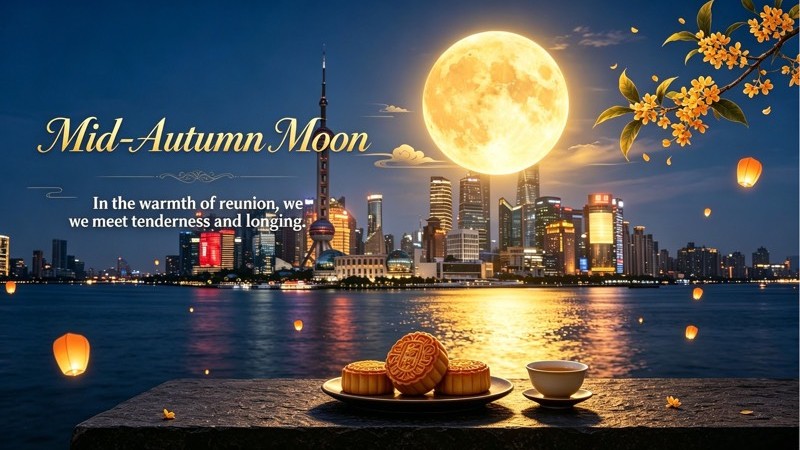
You cannot talk about Mid-Autumn Festival without talking about mooncakes. These dense, round pastries are usually filled with lotus seed paste or red bean paste, sometimes with a salted egg yolk in the center to represent the moon itself. Families exchange boxes of them as gifts, and gifting mooncakes to business partners is also a common custom, similar to how flowers are exchanged for other occasions.
Regional variations matter a lot here. Cantonese-style mooncakes tend to have thin, golden crusts. In Suzhou, you'll find flakier, more savory versions with pork filling. In Yunnan, some are stuffed with ham. Every region has its own pride around how the mooncake should be made, and locals will happily argue about which style is superior.
Lanterns, Osmanthus Wine, and Watching the Moon Together
Alongside mooncakes, lantern displays are a huge part of the celebration, especially for children. Cities light up with paper lanterns shaped like rabbits, fish, and flowers, and public parks often host lantern festivals where families walk together after dinner.
Osmanthus flowers bloom around this same time of year, which is why osmanthus wine and osmanthus-flavored sweets are traditional at Mid-Autumn gatherings. The scent of osmanthus in the air is one of my personal markers that the festival season has arrived — it's subtle, sweet, and always reminds me of standing outside my grandmother's house as a child.
The central ritual of the night, though, is simple: families sit outside, or by an open window, and watch the moon together. There's an old belief that the Moon Goddess Chang'e lives there, having drunk an elixir of immortality and floated away from her husband. Children are told her story while adults sip tea and share mooncakes, cutting them into pieces so everyone at the table gets a taste.
Why Flowers Matter for This Festival
In more recent years, sending flowers alongside mooncakes has become increasingly common, especially for people who can't travel home. At Pandora Flora, we see a clear pattern every Mid-Autumn season: orders lean toward round, full arrangements — chrysanthemums, lilies, and osmanthus branches when we can source them — paired with warm gold and white color palettes that echo the moon and the harvest season.
Chrysanthemums in particular carry meaning here, since autumn is considered their season and they're associated with longevity and resilience in Chinese culture. A bouquet built around them, delivered same-day to a parent or grandparent who can't be visited in person, has become one of our most requested Mid-Autumn orders.
If you're arranging a delivery for someone in China this festival season, my advice from years of doing this: order a few days ahead if you can, since courier volume spikes right around the festival date, and pair the flowers with a short, personal note. The gesture means more than the size of the bouquet ever will.
A Holiday Worth Understanding
Mid-Autumn Festival isn't loud like some other Chinese holidays. There are no fireworks at midnight, no red envelopes changing hands on every street corner. It's a quieter, more reflective celebration built around family, gratitude, and the simple act of looking up at the same moon as the people you love, wherever they are.
Having delivered flowers across this festival for more than a decade, I can tell you it never gets old watching a bouquet arrive on someone's doorstep at exactly the right moment, on exactly this night.